Migros tests a new model
for last mile delivery with RIVR robots

Automated last mile delivery at Migros
Last mile delivery is under pressure. Retailers and delivery operators need to handle growing e-commerce volumes while keeping service reliable, reducing physical strain on staff, and improving efficiency on the route. That is why the Migros Online, Swiss Post and RIVR field test is such an interesting use case for logistics leaders.
In September 2025, RIVR announced a collaboration project with Swiss Post and Migros Online to test automated doorstep deliveries in Regensdorf, near Zurich. The trial focused on how robotics can support delivery staff in real operating conditions without replacing the human role in the process. This project shows where reusable packaging meets automation-ready logistics.
Key takeaways
- Migros Online, Swiss Post and RIVR tested doorstep delivery robots in Regensdorf, Switzerland, in 2025.
- The goal was to explore how robotics can support delivery staff, improve efficiency, and reduce physical strain.
- Utz supplied nestable containers used on the robot.
- This use case highlights that robotics and reusable packaging need to work as one system.
- For logistics teams in retail and e-commerce, that makes this a useful example of practical innovation.
Why last mile delivery needs new support models
The last mile is one of the hardest parts of retail logistics to optimize. Delivery staff deal with repeated walking, stairs, heavy loads, short stops, and changing urban environments. For a Logistics Manager, the challenge is not only cost - it is also route efficiency, delivery consistency, and reducing operational strain without disrupting proven workflows.
That is exactly the problem this pilot tries to address. According to RIVR, the field test was designed to examine whether automation can improve efficiency, reduce physical strain for delivery staff, and support customer experience while fitting into established delivery operations. Swiss Post also emphasized that the goal was to understand how autonomous delivery systems might support people and processes, not replace them.
For retail and e-commerce operations, this is a practical innovation angle. It is not robotics for its own sake. It is robotics tested against real delivery constraints.
What Migros Online, Swiss Post and RIVR are testing
The project brought together three different roles in the delivery chain:
- Migros Online provided the e-commerce grocery context.
- Swiss Post acted as the logistics partner.
- RIVR supplied the autonomous doorstep delivery robot platform.
The test took place in Regensdorf, Zurich, with selected Migros Online grocery orders and Swiss Post parcels included in the trial.
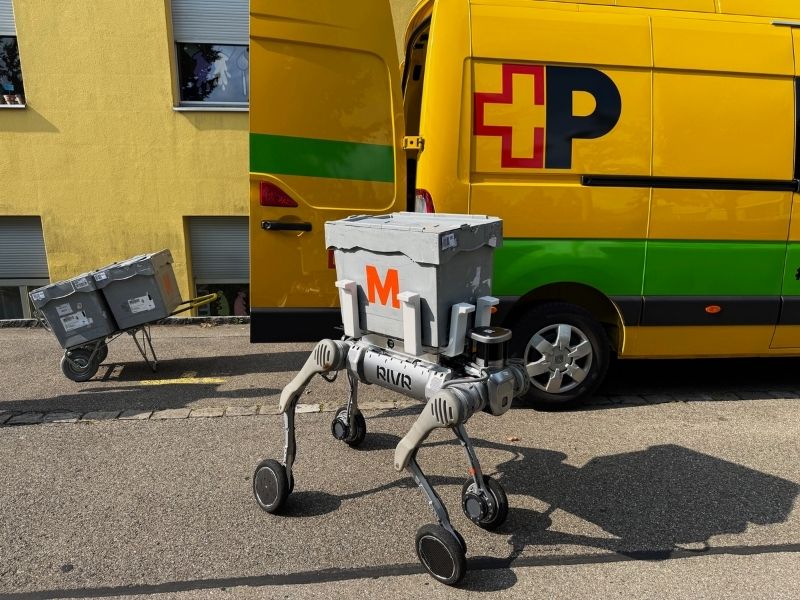
The public descriptions of the pilot are useful because they stay close to real operations. The robot accompanies a delivery worker and is tested on real delivery tasks such as sidewalks, stairs, and vehicle loading. The LinkedIn post from Migros Online also states that the robot was designed to support delivery staff by making work easier, safer, and less physically demanding.
RIVR describes its system as an autonomous delivery platform built for doorstep precision in complex neighborhood environments. The operational point is clear: the robot is being tested in the difficult final steps between the vehicle and the customer’s door.
Where reusable containers fit into the delivery workflow
Utz supplied nestable containers that can be placed on the back of the RIVR robot to support home delivery.
In last mile grocery delivery, a nestable container helps reduce empty return volume and makes handling more efficient once goods have been handed over. This is especially relevant in routes where delivery assets need to move back and forth between fulfilment, transport, and doorstep handoff.
For retail and e-commerce, reusable packaging supports:
- omnichannel optimization
- operational flexibility
- circular distribution flows
For a Logistics Manager, the key takeaway is that the robot is only one part of the system. The load carrier also has to work reliably within the same process.
What logistics leaders can learn from this use case
The most interesting part of this trial is the full delivery system behind it. It is not just a robot walking to the doorstep. It is a test of how people, vehicles, robots, and packaging can work together in a realistic delivery flow.
There are three practical lessons here:
- Future-ready last mile delivery depends on system compatibility. A robot may be highly advanced, but the surrounding load carrier still needs to be stable, easy to handle, and suitable for repeated use.
- Efficiency gains often come from reducing non-value-added effort. If a delivery worker can offload part of the carrying task, walking distance and physical strain can potentially be reduced. That matters in grocery delivery, where loads can be heavy and routes repetitive.
- Reusability remains important even in advanced delivery models. Retail and e-commerce operators are under pressure to improve sustainability as well as performance. That makes reusable packaging a practical part of future delivery design, not only a sustainability decision.
This is why the Migros Online and RIVR example is worth watching. It shows that innovation in last mile delivery is not only about autonomous mobility. It is also about choosing packaging that supports the workflow from the start.
Conclusion
The Migros Online, Swiss Post and RIVR pilot shows how last mile delivery is becoming more operationally integrated. Robotics, reusable packaging, and delivery workflows are being tested together in real conditions rather than as separate innovations.

FAQ
Was the robot meant to replace delivery staff?
No. The robot was intended to support delivery staff, not replace them. The public statements from the project and the Migros Online LinkedIn post say it was designed to make work easier and less physically demanding.
Why are containers important in this kind of robot delivery setup?
Because the robot still needs a reliable load carrier. In practice, the container has to support:
- safe transport
- easy handling
- repeated reuse
- a good fit with the delivery workflow
Why does a nestable container make sense for last mile delivery?
A nestable container reduces space during empty returns, which can improve storage and transport efficiency after delivery.